Travel Trends
Solar Eclipse 2026 Spain: Where to Watch & Stay
July 9, 2026 · VayCando · 15min read
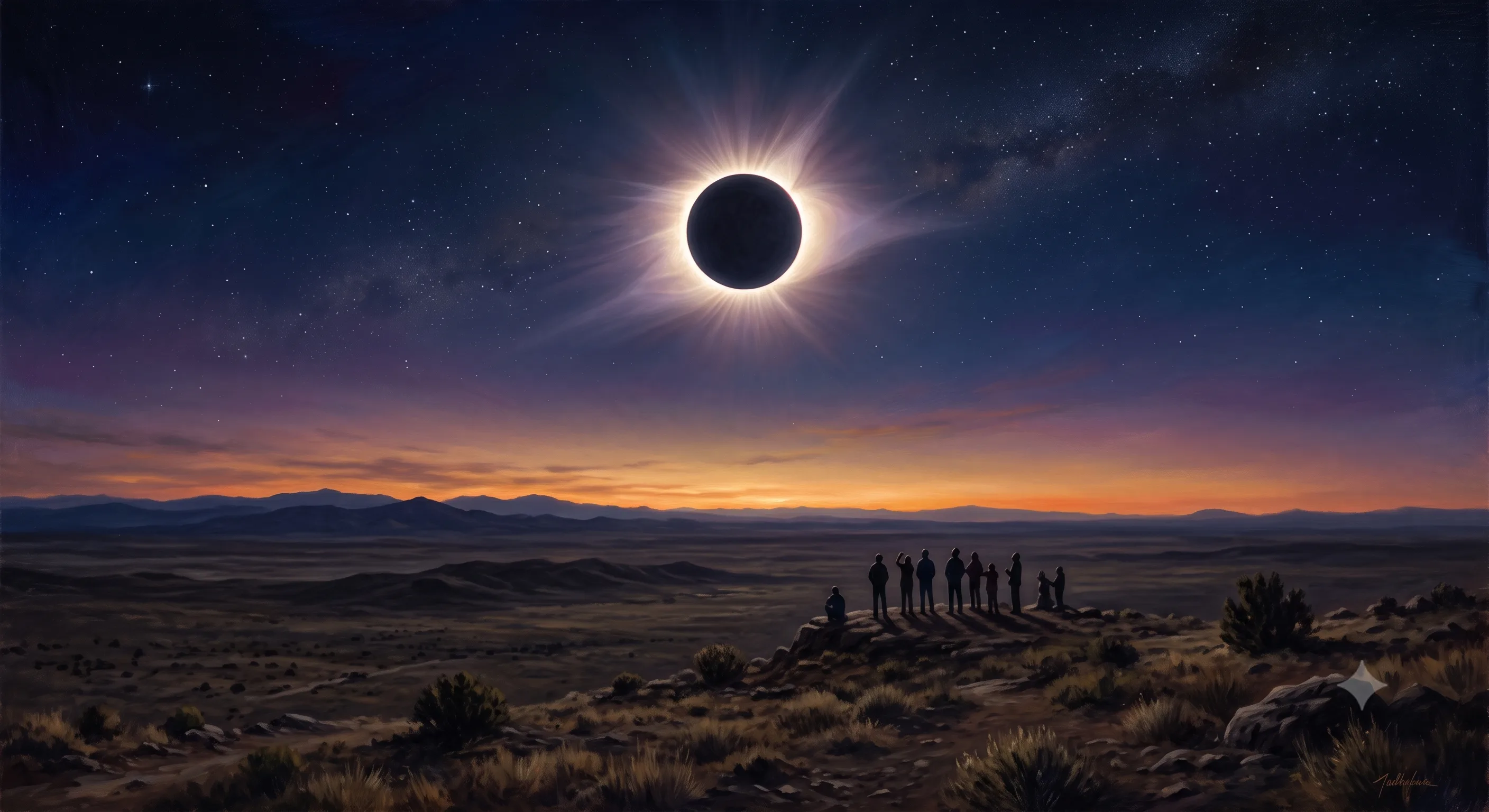
When did you last watch night fall in the middle of the day? Picture it: a warm late-summer evening in Northern Spain. The sun hangs low over the Atlantic, the light turns strangely metallic, the birds fall silent – and for one to almost two minutes, dusk arrives at midday. The 2026 solar eclipse in Spain is not a box to tick off. It is a reason to travel more slowly, to plan more deliberately, and to give a rare natural spectacle the space it deserves. That is exactly what we mean by slow travel around the solar eclipse in Europe.
On 12 August 2026, the Moon’s shadow sweeps across Greenland, Iceland and the north of Spain. For sustainability-minded travellers from Central Europe, that is an invitation to turn two minutes of darkness into a week-long, unhurried journey. In this guide you’ll find the best places to watch, tips for arriving by train, honest notes on weather and availability – and everything you need to observe safely.
A quick word on accuracy: The core astronomical figures in this article (date, times, the path of totality, duration) have been checked against official calculations as published by NASA (see eclipse.gsfc.nasa.gov) and specialist portals such as timeanddate.com. Even so, do reconfirm the exact times, the duration of totality and the sun’s elevation for your precise location on a reliable specialist source shortly before you travel.
Solar Eclipse 2026 in Spain: What Happens on 12 August 2026
The total solar eclipse on 12 August 2026 occurs when, from our vantage point, the Moon fully covers the Sun. Only within a narrow band – the path of totality – does it briefly go properly dark and the solar corona become visible. Outside that band you’ll see only a partial eclipse – nowhere near as striking.
How long the darkness lasts depends heavily on where you stand: the global maximum of 2 minutes and 18 seconds falls over the North Atlantic, roughly 45 kilometres west of the Icelandic coast. In Northern Spain, totality usually lasts under two minutes depending on the location – near the central line, around Gijón and Oviedo, about 1 minute 45 seconds. Even so, it’s worth checking a location-specific specialist source for your chosen spot.
According to astronomical calculations, the 2026 path of totality runs across eastern Greenland, western Iceland, straight over Northern Spain and the far northeast of Portugal. For travellers from Central Europe, that makes two regions practical above all: Iceland and Spain.
One important difference between the two:
- In Iceland the eclipse happens in the late afternoon, from around 17:00 local time – roughly four hours before sunset, with the Sun sitting noticeably higher in the sky.
- In Spain the event takes place in the early evening, at approximately 20:30 CEST – by which point the Sun is only about 10 degrees above the western horizon at most. That makes an unobstructed view to the west the decisive factor.
In our view, that is the central planning consideration: in Spain you need an elevated spot or an open coastal or plains location with no mountains or buildings to the west. A village in a valley may be idyllic – but if the Sun disappears behind the ridgeline before the Moon fully covers it, the whole journey was for nothing. That’s precisely why it pays to weigh both regions honestly against each other before you commit.
Spain or Iceland? Two Routes, One Spectacle
Northern Spain: Totality with a Low Evening Sun
According to the available calculations, the path of totality in Spain stretches across the north of the country – roughly from the Galician and Asturian Atlantic coast, over the Castilian plateau and the Ebro valley, towards the Mediterranean coast. For many Central European travellers Spain is the more appealing option, because it can largely be reached overland and the statistical weather odds inland are better than over the North Atlantic.
The draw: a low, eclipsed sun above the wide Meseta landscape or the cliffs of the Cantabrian Sea is an image you don’t forget. The challenge: an open western horizon and – frankly – competition for every last bed.
Iceland: Raw Nature, but Weather Risk
The 2026 solar eclipse in Iceland plays out against a dramatic backdrop of lava fields, coastline and open space, with the Sun standing higher. Because the event happens there in the afternoon, the Sun sits more comfortably in the sky than in Spain – an open western horizon is less critical. For many travellers, that’s a genuine argument in its favour.
The honest catch: Iceland is known for changeable, often cloudy weather. The chance that cloud hides the decisive moment is statistically higher than inland Spain. On top of that comes the journey – Iceland can’t be reached by climate-friendly rail, and a flight is hard to avoid. Anyone visiting the island therefore ideally plans a longer trip anyway, making the eclipse the highlight rather than the sole purpose.
Who is Iceland still worth it for? For anyone who loves rugged nature, brings several weeks of time, and consciously accepts the weather risk. Those who value a sustainable journey and want to improve their odds of a clear sky are usually better served by Northern Spain. Both routes lead to the same sky-show – they differ only in how much you’re willing to take on for that look upward.
The Best Places to Watch the 2026 Solar Eclipse
Based on current knowledge, the following regions lie in or near the path of totality in Spain and Northern Spain. Treat them as a starting point for your own research, not a second-by-second guarantee – you should double-check the exact position of the central line for your chosen spot.
Location Profiles at a Glance
Asturias & the Cantabrian coast Cliffs with a clear view of the Atlantic to the west – ideal for a low sun over the sea. Green, unhurried landscape, a good base for hiking. Weather risk: coastal fog and cloud rolling in off the Atlantic.
Castile and León (Meseta, around Burgos/Palencia) A wide plateau, often clear skies, plenty of elevated spots with an open horizon. Historic towns invite you to linger. In our assessment, one of the most balanced options for weather and accessibility.
The Ebro valley and Aragón (around Zaragoza) A dry inland climate with statistically good chances of a clear view. Well connected by rail. Look for a spot with an open western horizon.
The Mediterranean coast (optional, edge of the zone) For anyone who wants to combine the event with the sea and Mediterranean calm. Here the central line only just clips the far edge of the country, and the Sun sits especially low – a coastal spot with a clear view over the water is a must. The Balearics are grazed by the central line at best; if that’s your plan, check the exact position with particular care.
Practical box: how to find your specific spot
- Is the location inside the path of totality? Only there will you see the full eclipse. Just a few kilometres off, the experience is noticeably weaker.
- Is the western horizon clear? No mountains, forests or buildings in the direction of the low sun.
- Is there an elevated vantage point nearby? A hill, a rise or an open coast improves your odds considerably.
- Is it accessible but not overrun? Small villages away from the hotspots often offer more calm.
In our view, these criteria matter more than a place’s evocative name. The best places to watch the 2026 solar eclipse are rarely the ones everyone talks about first. If dark skies fascinate you in general, Europe holds still more rewarding destinations.
And that raises the next question: how do you actually get there without betraying the unhurried idea right at the start?
Travel Sustainably: Reaching the Eclipse by Train
At VayCando, the journey is part of the destination. And few occasions lend themselves better to making travel itself the experience than reaching a solar eclipse by train.
From Central Europe, the climate-friendly overland route typically runs via France. One possible, unhurried itinerary:
- Central Europe → Paris by long-distance rail (e.g. from Frankfurt, Stuttgart, Munich or Zurich).
- Paris → Barcelona by high-speed train – one of the most comfortable cross-border rail connections in Europe.
- Barcelona → Northern Spain onwards on Spanish long-distance services towards Zaragoza, Burgos, Cantabria or Asturias.
Deliberately allow two travel days with one overnight stop en route – in Paris, say, or somewhere in southern France. That way the journey doesn’t become a source of stress but the first chapter of your trip.
Practical box: rail tips for the eclipse trip
- Book early: cross-border saver fares are limited in number and sell out fast during the August holiday season. Many connections can be booked several months ahead.
- Plan generous connections: better a longer changeover than a missed onward train.
- Stay flexible within Spain: local buses and a hire car on the ground help you reach the final spot with an open western horizon – even when it lies off the rail line.
- Spread out the return: travel back a day or two after the eclipse. The day after, everyone wants to leave at once.
Travelling this way is slow travel around the solar eclipse in Europe in its purest form: less CO₂, more landscape, more stopovers, more history along the way. That leaves just one question you’d do well to settle sooner rather than later: where will you sleep on the night of the eclipse?
Booking Accommodation for the Solar Eclipse in Spain — Now
Here comes the honest part, without manufactured drama: anyone who wants to book accommodation for the solar eclipse in Spain shouldn’t wait until spring 2026. Rare astronomical events draw travellers from all over the world, and the number of beds in or near the path of totality is limited – especially in smaller places with a good horizon.
This isn’t a sales tactic, simply experience with comparable events: well-placed accommodation in narrow paths of totality is often booked out long in advance, and prices climb as demand rises. We’ve summarised separately how to book early for natural events and still stay relaxed about it.
Checklist: choosing accommodation wisely
- Location before amenities: a simple guesthouse with a clear view west beats the lovely hotel in a narrow valley.
- In the zone, not just nearby: before booking, confirm that the address really lies within the path of totality.
- Check cancellation terms: flexible rates give you room to manoeuvre if the weather forecast worsens later.
- Book regional and family-run: small guesthouses, agriturismos and country farms keep the value in the region – very much in the spirit of sustainable travel.
- Expect a minimum stay: many places require several nights around the event. Use them to really get to know the region.
A slow-travel thought on the side: stay longer than just the one night. Spend a week in Asturias, Cantabria or on the Castilian Meseta and you experience not one or two minutes of eclipse, but a whole region – its food, its trails, its pace.
Watch Safely: Your Eyes Are Irreplaceable
As calm as this guide is otherwise – on safety there is no room for compromise. Looking directly at the Sun can damage the retina permanently and painlessly. That applies during the partial phases of an eclipse too.
The key rules:
- Never look at the Sun unprotected – not with the naked eye, not through sunglasses, not through a camera, binoculars or telescope without a certified special filter.
- Use only tested solar eclipse glasses to ISO 12312-2. Ordinary sunglasses offer no adequate protection whatsoever.
- Check the glasses for scratches, holes or creases before use. Damaged filters belong in the bin.
- Binoculars and telescopes need their own solar filters fitted in front – eclipse glasses at the eye are not enough; the concentrated light would be dangerous.
- Always supervise children.
The one exception: only during the total phase – that is, when the Sun is fully covered by the Moon and the corona appears – may and should you look with the naked eye. That’s exactly when the real spectacle reveals itself. The moment the first sliver of sunlight flashes at the edge again, the rule returns instantly: glasses on. This phase exists only in the narrow path of totality – and depending on the location it usually lasts under two minutes (in Northern Spain around 1 to almost 2 minutes). Outside the zone it doesn’t happen at all.
Get your ISO 12312-2 solar eclipse glasses from reputable suppliers in good time. Experience shows that tested glasses grow scarce just before such events, and products with questionable labelling also circulate.
Weather and Availability: Honestly Planned, Not Blindly Hoped
Part of being straight with you is promising no guarantee of success. Whether you actually see totality comes down to the weather in the end – and that can’t be predicted months ahead.
What you can realistically plan for:
- Use the statistical odds, don’t overrate them: inland Spain offers clear skies more often in August than the Atlantic coast or Iceland. That’s no guarantee – local cloud is always possible.
- Stay mobile: if you’re not tied strictly to one address, you can switch at short notice to a spot with a better view when the forecast turns. A hire car for the final days buys you that flexibility.
- Factor in the low sun: in Spain, the clear western horizon is part of the equation. Even under a clear sky, a bank of cloud just above the horizon can hide the decisive moment.
- Build in a buffer: arrive a few days early. That way you avoid time pressure, can explore the region, and are relaxed and in place on eclipse day.
In our view, the right inner attitude is decisive: plan carefully, improve your odds where you can – and enjoy the journey so that it’s worthwhile even if a cloud arrives at the crucial moment. That is exactly where the heart of unhurried travel lies.
Your Checklist for the 2026 Eclipse Trip
Compact, to take with you:
- Region decided: Northern Spain (sustainable journey, better weather statistics) or Iceland (raw nature, higher sun, but greater weather risk)
- Specific spot in the path of totality with an open western horizon researched
- Exact times, duration of totality and sun elevation for the location checked on a specialist source
- Rail connection booked early, arrival and return spread out
- Accommodation in the zone secured on a flexible rate
- Tested ISO 12312-2 solar eclipse glasses obtained
- Weather plan B and mobility for the final days considered
- Enough time set aside to really experience the region
Two Minutes Worth a Whole Journey
The total solar eclipse on 12 August 2026 is a promise: that slow, deliberate travel is worth it. Plan early, arrive by train, secure accommodation in the path of totality in good time and watch safely, and you turn a fleeting sky event into a journey you’ll remember for a lifetime.
And the first step is smaller than you think: take twenty minutes this evening. Decide on a region – Northern Spain or Iceland. Open the rail journey planner and see when saver fares to Paris and Barcelona are released. Add a pair of tested eclipse glasses to your list. Not out of haste, but out of anticipation.
Ready for your slow-travel journey to the 2026 solar eclipse? Browse the VayCando trip ideas for Northern Spain now, lock in your route and accommodation – and give the experience the time it deserves. It begins with the first kilometre of track, not with the darkness.